
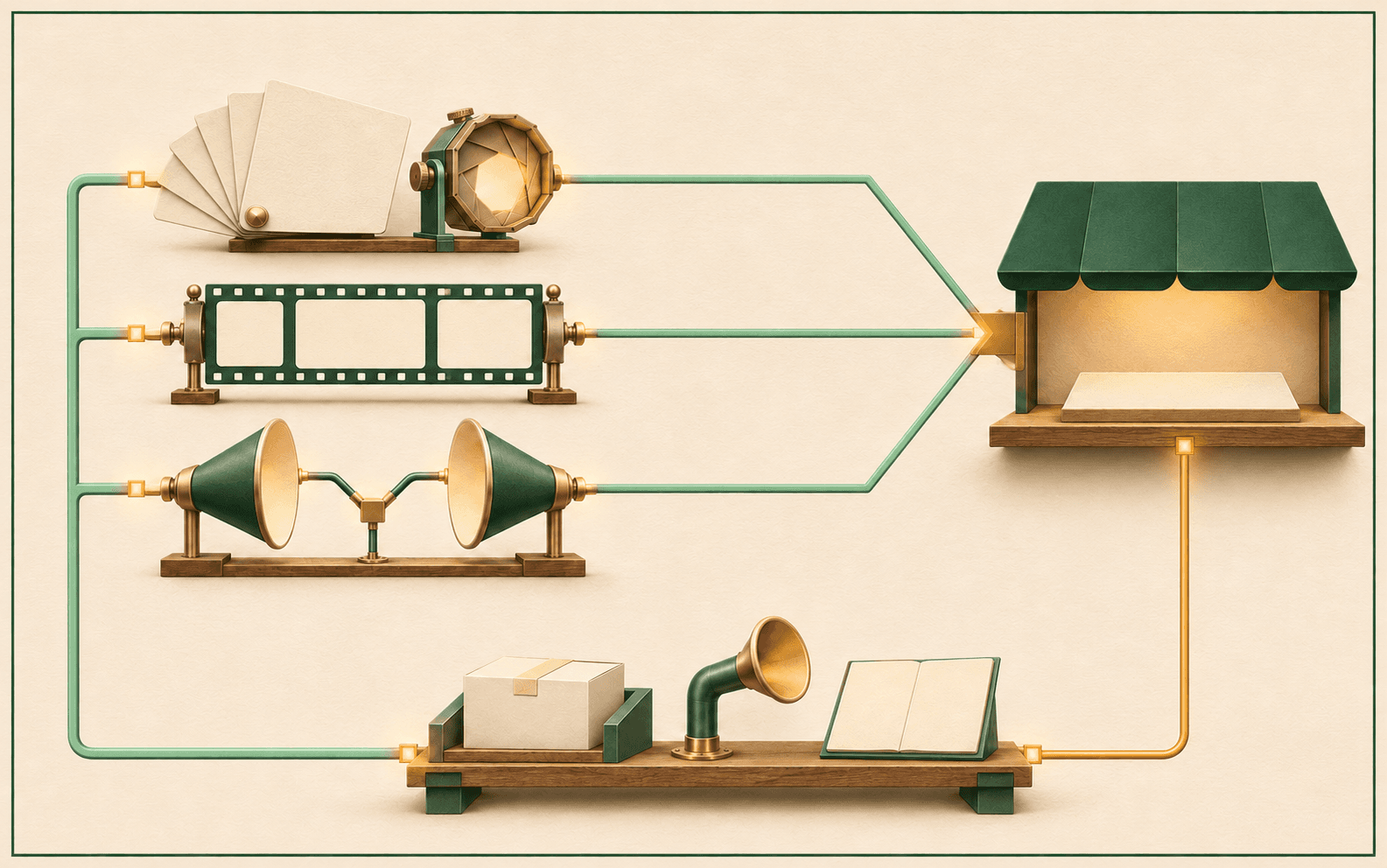
The familiar proposal is easy to assemble: Search for intent, Instagram for awareness, YouTube for education, TikTok for discovery, and retargeting to bring everyone back. Each line sounds plausible. Together, they can hide the fact that nobody has decided which customer to pursue first, which offer the destination can explain, or who will answer the enquiries.
A better plan starts with a more demanding question: which uncertainty is worth paying to resolve now? The answer determines the first channel job. The product page, creative, response process and capacity limit belong in the same decision.
Start with the business that must receive the traffic
Illustrative planning scenario: Nera Counter Display, its product, team, contacts, service zone and every figure below are fictional. They are inputs for comparing planning choices, not an Aright campaign, observed demand, actual supplier prices or a forecast of enquiries or sales.
Nera sells two fixed-size flat-pack countertop display kits to independent retailers. It does not offer bespoke store design. For its first US pilot, assume the operator has already verified one limited delivery zone, the two product configurations, the quotation process and the relevant account/market eligibility. That assumption establishes this imaginary exercise; it does not establish any real US route or Aright coverage.
The team consists of a founder/operator and one marketer. Together they can spend 16 hours a week on the pilot. The operator can perform at most six new substantive quotation reviews in a rolling seven-day window. These are work slots, not orders or a forecast of customers.
The planning assumption is a 10–30-day buying cycle, which must itself be checked. A four-week acquisition pilot can reveal useful questions and process failures, but the last enquiry cannot be declared a lost or profitable customer simply because the calendar reaches the end of the month.
The immediate decision is not how to divide money between five platforms. It is whether the team can find and handle relevant retailer questions without buying more response than it can examine.
Give three routes different jobs
Nera chooses three complementary routes. Only one initially receives paid acquisition spend.
| Route | Its first job | Evidence worth examining | What it cannot establish alone |
|---|---|---|---|
| A tightly scoped Search test | Find out whether specific expressed buying questions match the kit offer and service zone | Actual search terms, destination behaviour and reviewed enquiries | A keyword match or click does not establish an appropriate buyer, feasible delivery or a sale. |
| An owned demonstration, also available on YouTube | Help a visitor or contact understand the two footprints, pack contents and assembly overview | Which explanation is used, where questions remain, and whether people can identify the relevant configuration | A view or a retention spike does not establish comprehension or buying intent. Organic reach is not assumed. |
| Founder conversations with a small permissioned partner-contact group | Learn who specifies the fixture, what blocks a decision and how the quotation route fits buying practice | Specific objections, buying roles and requests that can be checked against the offer | A few conversations do not estimate the whole market or demonstrate a scalable acquisition channel. |
The demonstration is not a separate promise to attract a large audience. It is an explanation used on the destination and in conversations; YouTube is an additional place to access it. A visitor arriving from Search may use it, while a partner may share it before anybody searches. There is no required sequence through the three routes.
Google's campaign-type guidance describes Search campaigns as text ads in search results. That surface makes a test of expressed questions plausible. It does not prove that sufficient relevant searches exist or that Search deserves the largest budget in every market.
Before funding the test, Nera checks the actual intended account, market, audience, query evidence and destination. If that preparation finds no credible category-specific demand to test, the Search authorization stays unspent. The team first uses the partner conversations to refine the question rather than manufacturing a campaign to fill an empty schedule.
Make the budget a set of choices
The four-week cash authorization is USD 2,400:
| Work | Authorization | Why it is funded now | Condition on use |
|---|---|---|---|
| One product-and-quotation destination | $700 | The two configurations, served route and next step must be understandable before visits are purchased. | Fix contradictions before acquisition starts. |
| One demonstration and annotated stills | $400 | Reusable explanation can support Search visitors and partner conversations. | Show the supplied facts; do not invent performance claims. |
| Search media | $900 | Examine a bounded set of relevant buying questions after readiness checks. | Pause for capacity, destination or relevance failures; unused money need not be spent. |
| Tracking and journey QA | $200 | Confirm that the intended events and enquiry handoff work. | A test submission must arrive and be distinguishable from a real request. |
| Uncommitted reserve | $200 | Preserve the option to correct a specific problem. | Release only for a named change; do not automatically launch another platform. |
The total is $2,400: $2,200 assigned and $200 uncommitted. These are illustrative authorizations, not market-rate estimates. They buy a small, interpretable attempt, not a promised number of contacts.
The $900 media line is also not a provider-enforced spending guarantee. Google explains that average daily spend can vary above or below the average daily budget. The operator must check the actual account's budget, billing and stopping controls rather than assume that dividing $900 by a number of days creates a hard daily or overall cap.
Time needs the same honesty. The founder's eight weekly hours are allocated to quotation reviews four hours—six reviews at an assumed 40 minutes each—partner work two hours, operational handoff one hour, and the weekly decision one hour. The marketer's eight hours cover query/spend review two hours, creative and page changes two hours, measurement and enquiry triage two hours, and QA/review two hours.
If the work takes longer, the six-review capacity is no longer supported by this time plan. The team must reduce intake, change the scope or add real capacity. It cannot solve the shortfall by giving the same hours a more optimistic label.
Write the ad and destination together
A candidate Search message for the fictional offer is concrete enough to examine:
Counter Displays for Retail
Two Fixed-Size Kit Options
Check Fit Before a Quote
Compare both kit footprints and flat-pack contents. Request a layout and delivery check.
Two kit sizes. No bespoke shop fit-outs. See the dimensions before requesting a quote.
This is example copy, not an approved live advertisement. It deliberately avoids “complete store transformation,” “instant installation” and an unverified delivery promise. Those might attract a different task from the one Nera can serve.
The fictional destination, /counter-display-kits, must continue the same promise. Its useful core could read:
Choose between two countertop display kits
Compare each kit's footprint, pack contents and assembly overview before requesting a quotation. These are fixed configurations, not a bespoke store-design service.
Request a configuration and delivery review
Tell us which kit you are considering, your available counter space, quantity, delivery ZIP code and required timing. We check the configuration and delivery eligibility before issuing a quotation. Our initial-response target for this pilot is two working days.
A request does not reserve stock or a delivery date. If your location is outside the served zone or your requirement is outside the two configurations, we will explain that rather than issue a misleading quotation.
Above the request, the page shows the two actual configuration sheets, current availability information and the demonstration. The intake captures a business question and a feasible next step. It is not a generic “Contact us” box attached to a more expansive advertising promise.
The query candidates are similarly specific: examples such as “countertop display kit” and “flat-pack retail counter display” express a different task from “shop interior designer.” These are hypotheses to check, not researched volume claims. The team reviews the actual search terms and the questions they bring.
Google's matching guidance matters here: exact match can include the same meaning or intent, not merely an identical string. Naming a keyword therefore does not remove the need to inspect what the campaign actually matched. Exclude or revise irrelevant coverage using the controls appropriate to the live account; do not explain it away as useful awareness by default.
Make one demonstration serve a specific uncertainty
The first creative brief is small enough for this team to maintain:
| Shot | What is shown | Question it answers |
|---|---|---|
| 1. The two footprints | The supplied dimensions of both configurations overlaid on a counter outline, with the comparison readable as text | “Which configuration should I examine for my available space?” |
| 2. The flat-pack contents | All included pieces laid out and identified against the configuration sheet | “What is actually included, and what would I still need to ask about?” |
| 3. The assembly overview and next step | The sequence from the supplied instructions, without unverified speed/load claims, followed by the configuration-and-delivery review link | “Can I understand the proposed setup and ask a precise question?” |
It is a planned asset, not existing footage or a real assembly test. Text and annotated stills carry the same essential information for people who do not watch the video. A second lifestyle edit can wait until a specific audience or placement gives it a different job.
The team uses remaining questions to decide what to improve. It does not simply reward the longest viewing time. YouTube notes that a retention spike can reflect rewatching because a section is unclear. That is a reason to inspect the explanation alongside viewer questions, not a reason to report that intent or understanding increased.
Sequence the first month around what can be learned
Week 1: make the next step real. Complete the destination, configuration sheets, demonstration and event checks. Send an internal test request through to the operator, including an unserved ZIP-code scenario. Verify that the stated response target is workable. Confirm relevant query evidence and account/market eligibility before authorizing media to run.
Weeks 2–3: run the bounded acquisition test. Search addresses the agreed buying questions within the verified pilot scope. The founder works through a pool of 12 fictional permissioned partner contacts, using the two weekly partner-work hours for preparation, conversations and follow-up. Twelve contacts are a work list, not twelve promised meetings or sales. Contacting more people does not become the goal when the assigned hours run out.
The media plan pauses when four new substantive quotation-review slots are booked in a rolling seven-day window. The two remaining slots are reserved for organic/partner enquiries and catch-up; those enquiries consume the same total six-slot capacity. This is a backlog control, not a target of four orders. Keep responding to existing requests and providing help when acquisition pauses. Resume only after checking the queue and the operating promise, not simply because the ad account is able to spend again.
Week 4: develop the decisions and follow-up. Inspect actual queries, incomplete or mismatched requests, unanswered questions, time spent reviewing and progress through quotations. Continue following each acquired enquiry through the assumed buying cycle; later cohorts need later observation. The month-end report should say what remains open rather than classify every open quotation as a channel failure.
Record the difference between a platform event and a business outcome
Nera's working chain is short: visit → request received → human review → quotation where appropriate → subsequent outcome. Each step answers a different question.
The marketer checks that a request event corresponds to a received, non-test submission. The operator then records whether the requested configuration, delivery zone, quantity and timing can be served; if not, the reason matters more than an attractive event total. Where a quotation is appropriate, it receives its own status and follow-up date. A platform-attributed request is never silently renamed a qualified opportunity or an order.
Track how the visitor says they found the product alongside available campaign information, using the permissions and data practices applicable to the actual implementation. Someone may have seen the demonstration in a partner conversation and searched later. Giving the last click all the credit would not explain the commercial role of that conversation.
The purpose in this first test is a better next planning decision. It is not a controlled estimate of channel incrementality or a financial reconciliation of profit.
Let the evidence change the order
If relevant searches exist but requests repeatedly ask for bespoke store design, revise the query coverage, message or destination before buying more visits. If small diagnostic conversations reveal that fixture selection belongs to a distributor rather than the retailer, investigate that route; the initial audience definition may be wrong.
If the demonstration is being used but people still cannot distinguish the two configurations, repair the explanation. More distribution of the same ambiguity is not the next sensible investment.
If appropriately matched enquiries consume the four booked review slots quickly, pause paid acquisition even when the apparent demand looks encouraging. Resolve response and delivery capacity before enlarging exposure. Operational constraints can override a promising media signal.
Conversely, if query evidence is too sparse to support the proposed Search test, it may be sensible to spend more of the team's learning time on permissioned conversations and a narrower buyer problem. That is not proof that Search “does not work.” It means this particular question has not yet earned this particular media test.
What the team is deliberately not funding
For this first pilot, Nera does not fund broad paid video, separate Meta/Instagram/TikTok campaigns or retargeting. It has not yet established an additional audience/message job, suitable creative and a usable response path for each. Retargeting also needs a valid eligible audience and the applicable permission/account setup; a small visit count is not itself an executable plan.
This is a conditional allocation, not a permanent ranking of platforms. A business with an established visual audience, a short purchase cycle, a usable transaction destination and spare service capacity could make a different choice. Expansion to Southeast Asia or another global market also requires checking the local buyer task, route, language and current platform availability rather than copying the US settings.
The next channel earns funding when the team can name the new uncertainty it will resolve, show a destination that continues the promise, and explain who can act on the response. A smaller plan that answers those questions is more useful than a complete platform list that cannot.